

It has been scientifically proven that a tidy desk can help reduce visual distractions and support focused work. This insight has led many organizations to introduce a so-called Clean Desk Policy.
But what exactly is behind this concept, and why is it so effective? In this blog post, you’ll learn everything you need to know about the Clean Desk Policy and why implementing it can also be beneficial in your office!
What Is a Clean Desk Policy?
The Clean Desk Policy (CDP) is a company policy that requires employees to completely clear their workstations of sensitive documents, storage devices, and personal belongings when leaving their desks. It defines how workspaces should be organized and left behind, particularly when handling confidential data, documents, and work equipment.
The goal is to keep workstations clean, organized, and secure at all times.
In practice, this means that whenever employees leave their desks whether for a break or at the end of the day no documents, notes, or personal belongings should be left out in the open, ensuring that colleagues find the workspace clean and ready to use.

The Most Important Rules of a Clean Desk Policy
For a Clean Desk Policy to work effectively in everyday business operations, it requires clear rules. While the policy often plays a secondary role in traditional offices with permanently assigned desks, it is almost indispensable in desk-sharing and hybrid work environments. Clear guidelines help ensure that sensitive information remains protected and that workstations can be used by other employees at any time.
What Is the 3P Rule of the Clean Desk Policy?
A simple framework for implementing shared desk guidelines is the 3P Rule. It divides the most important aspects of workplace organization into Plan, Protect, and Pick-up—three key principles for successful implementation.
Plan: Before work begins, only the documents, materials, and work tools that are actually needed should be kept on the desk. A tidy workspace makes organization easier and reduces distractions throughout the workday.
Protect: During work, the focus is on protecting sensitive data and information. Confidential documents should not be left visible, screens should be locked when leaving the workstation, and important records should be stored securely.
Pick-up: After work, all documents, work materials, and personal belongings should be cleared away. This step is particularly important in desk-sharing environments to ensure that workstations remain available for use at any time.
The 3P Rule therefore provides a simple framework for the practical implementation of a Clean Desk Policy and helps organizations combine data protection with efficient workspace utilization.
Key Measures at a Glance
In addition to the 3P Rule, several practical measures can help ensure that the Clean Desk Policy is implemented consistently in everyday work:
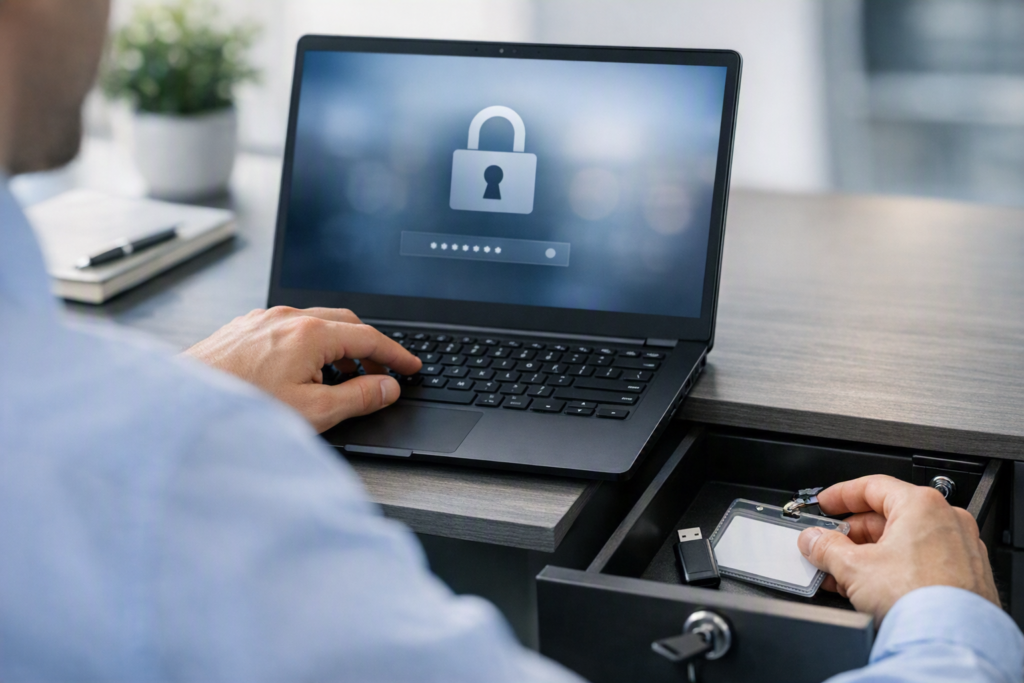
– Lock the screen: Lock your computer when leaving your workstation – on Windows using Win + L, on Mac using Ctrl + Cmd + Q.
– Store confidential documents securely: Sensitive documents and files belong in lockable cabinets or mobile pedestals, not left openly on the desk.
– Secure portable storage devices: Never leave USB drives, external hard drives, or company ID cards unattended; store them securely instead.
– Check notes: Avoid sticky notes containing passwords or customer data and dispose of documents that are no longer needed in compliance with data protection regulations (e.g. using a shredder).
– Clear the workstation at the end of the day: Before finishing work, completely remove all unnecessary items from the desk so that the workspace can be used immediately by someone else.
Example from Everyday Office Life
Max works at DEIN RAUM and has booked a workstation for the day. After his final meeting, he puts away his documents, locks his laptop, and takes all of his personal belongings with him.
When Lisa uses the same workstation the next morning, she finds a clean and organized desk and can start working right away.
👉 Start your free one-month trial of the DEIN RAUM application and take advantage of the benefits highlighted in Tip #7.
Clean Desk Policy and Desk Sharing: Benefits and Importance in Shared Workspaces
Workplace organization not only brings more order to the office but also offers many tangible benefits for both companies and employees. The importance of clear workplace guidelines becomes especially evident in modern office concepts such as desk sharing.
Data Protection and Compliance
A key benefit of a Clean Desk Policy is the protection of sensitive data. Open documents, notes, or unlocked computer screens can quickly result in confidential information being viewed by unauthorized individuals. This is a particularly significant risk in open-plan offices or desk-sharing environments, where multiple people use the same workstation. Clear guidelines help ensure that all important documents are stored securely and that no sensitive information is left openly accessible.
This not only helps in day-to-day operations but also supports compliance with legal requirements such as the General Data Protection Regulation (GDPR). As a result, organizations can reduce the risk of data protection breaches and achieve a higher overall level of security.
Productivity and Efficiency in the Office
A tidy workspace has a direct impact on the way people work. When unnecessary documents or personal items are not cluttering the desk, it becomes easier to focus on the tasks at hand. Employees spend less time searching for documents and can work in a more organized and structured manner.
At the same time, a clear Clean Desk Policy reduces distractions in the workplace. This not only improves concentration but can also enhance overall performance. Employees who arrive at a neat and organized desk in the morning often start their day feeling more relaxed and become productive more quickly.
In the long term, this leads to more efficient workflows throughout the company and supports better overall management and workplace organization.
A Prerequisite for Modern Workplace Concepts
The CDP is a key prerequisite for modern workplace models such as desk sharing and hybrid work. When employees arrive at a new workstation in the morning, they expect it to be ready for immediate use. A Clean Desk Policy ensures exactly that. Workstations are prepared, clean, and ready to use without any loss of time or the need for additional coordination. This reduces frustration and makes everyday work more efficient overall.
In addition, the policy promotes a respectful team culture. When everyone takes responsibility for maintaining a clean workspace, it strengthens a shared understanding of organization, cooperation, and mutual respect in the office. A tidy and well-structured work environment also conveys professionalism and enhances the company’s image both internally and externally.
Challenges of a Clean Desk Policy in Desk Sharing
The introduction of a Clean Desk Policy offers many benefits, but it can also present companies with several challenges in day-to-day operations. Especially in desk-sharing environments, employees often need to adapt their established work habits. To ensure the policy is successful in the long term, potential obstacles should be identified and addressed at an early stage.
Employee Acceptance
One of the biggest challenges when introducing a Clean Desk Policy (CDP) is gaining employee acceptance. Many employees are accustomed to keeping documents, data, or personal belongings at their workstations on a permanent basis. As a result, the requirement to regularly clear their desks completely may initially be perceived as an intrusion on personal freedom or as a restriction on their preferred way of working
Additional Organizational Effort
The additional effort involved in daily desk clean-up, storing documents, and securing data requires time and discipline. Without clearly defined processes, these activities can be perceived as extra work and may temporarily affect productivity.
Consistent Implementation and Monitoring
Another challenge is that the policy only works if it is consistently followed by all employees. If confidential documents or sensitive information are left exposed on workstations, risks to data protection and information security remain. Organizations therefore face the task of defining clear rules and ensuring their long-term compliance.
This becomes particularly important in desk-sharing environments. Since multiple people use the same workstations, every desk must be left ready for the next user after use. If documents, work materials, or personal belongings are not cleared away, it can hinder the flexible use of workspaces and lead to frustration within the team.
Sensitive data, documents, and work devices must also be protected from unauthorized access outside the office. At the same time, compliance is much more difficult to monitor, as managers and leadership teams cannot directly verify whether the rules are being followed.
The successful implementation of a Clean Desk Policy therefore depends not only on clear guidelines but also on a high level of employee awareness regarding data protection and information security.
Implementing a Clean Desk Policy: How to Ensure Successful Adoption
Implementing a Clean Desk Policy involves more than simply creating a new guideline. For the rules to become part of everyday work routines, employees must understand the objectives behind the policy and be able to apply its requirements consistently.
Step-by-Step Implementation
1. As a first step, companies should define the objectives they want to achieve with the Clean Desk Policy. The focus is often on data protection, information security, desk sharing, or a more efficient use of workspaces.
2. The rules should then be documented in writing and made easily accessible to all employees. The policy should clearly define how documents and sensitive data are to be handled and what requirements apply when leaving a workstation.
3. Another important step is raising employee awareness. Anyone who understands the benefits of the Clean Desk Policy is much more likely to comply with the rules. Therefore, companies should explain the background of the policy and regularly draw attention to topics such as data protection, information security, and the secure handling of confidential information.
4. In order for the implementation to succeed in everyday work, the necessary framework conditions must also be created. These include, for example, lockable cabinets, secure storage options for documents, or clear processes for the data protection-compliant disposal of documents.
Especially in companies with desk sharing and hybrid working models, the Clean Desk Policy should not only apply to the office. Sensitive data and work equipment must also be protected against unauthorized access when working from home, at a client’s premises, or at other workplaces.
5. Managers and leadership should actively support the policy and lead by example. In this way, the Clean Desk Policy becomes a long-term part of the corporate culture and not just another policy on paper.
Role of Tools and Software
The implementation of a Clean Desk Policy is significantly facilitated by digital tools. Especially in desk-sharing environments, desk booking systems help manage workspaces flexibly and make them transparently available to all employees.
Our desk-sharing software DEIN RAUM for flexible workplace booking supports you in complying with the Clean Desk Policy in your daily work.
You can now test the DEIN RAUM desk-sharing software free of charge for 30 days at deinraum.io.



 FREE TRIAL