
The 30-hour workweek (also referred to as the 30-hour model or 30h week) could soon become a new standard in the modern workplace. At least, this is one of the future scenarios proposed by the Zukunftsinstitut (Future Institute). Within the megatrend of New Work, this concept is gaining increasing attention—especially as more people want to work less while enjoying more free time.
But what exactly is behind this idea, and what advantages and disadvantages does it bring? This article explores the key aspects of the 30-hour workweek and looks at best practices, including examples from Sweden.
Read more about another compelling New Work concept here: UNLIMITED VACATION – MORE FREEDOM OR RATHER MORE STRESS?

- What does the 30-hour workweek mean?
- Salary in a 30-hour workweek
- Leave entitlement and break regulations
- Advantages of the 30-hour workweek
- Disadvantages of the 30-hour workweek
- Company examples from Sweden, New Zealand, and Austria
- Alternative working time models
- 30-hour workweek and workplace booking: what companies should prepare
- Frequently asked questions about the 30-hour workweek (FAQ)
What does the 30-hour workweek mean?
The 30-hour workweek refers to a working time model in which the regular weekly working hours are reduced to 30 hours, usually with the same salary as a 40-hour workweek. The focus is not on the number of hours worked, but on the results achieved. The idea behind this is to maintain performance and quality despite shorter working hours through more efficient work processes.
30-hour workweek: full-time or part-time?
Whether a model with reduced working hours is considered a standard arrangement or rather a part-time job depends largely on the industry, the collective agreement, and the company in Germany. While 40 hours per week is commonly the standard, 37.5 or 35 hours can also be defined as the norm. Legally, employees are classified as part-time if their agreed working hours are below the standard within the same company. Therefore, a 30-hour workweek can also be considered full-time—namely when all employees in the company work no more than 30 hours per week.
How are the 30 hours distributed across the week?
The distribution of the 30 working hours per week can vary and is usually based on the needs of both the company and the employees. There is no fixed model; instead, many companies rely on flexible solutions.
Working hours are often spread across five shorter days, for example with six hours per day. Other models bundle the hours into a four-day workweek, creating an additional day off each week. This four-day concept is considered particularly attractive, as it allows for longer recovery periods and more free time.
Example (flexible 4-day model):
2 days per week with 8 hours each
2 days per week with 7 hours each
1 day off per week
Additionally, flexitime or flexible start times can help integrate the agreed working hours optimally into the daily work routine.
Salary in a 30-hour workweek
The question of salary plays a central role in this new concept. The key factor is whether the reduced number of hours is implemented with or without salary compensation. Both variants exist in practice and differ significantly in their impact on employees and companies.
With or without salary compensation?
In the version with salary compensation, the salary remains at the level of a traditional full-time position despite the reduced number of hours. This means less working time with the same income. The prerequisite is that processes are made more efficient and productivity per hour increases. This approach is often used in pilot projects or within modern New Work concepts.
Without salary compensation, however, the pay is reduced proportionally. In Germany, earnings for a 30-hour workload are usually around 75% of the corresponding full-time salary (based on 40 hours). The reduced working hours therefore lead to lower income, similar to a traditional part-time job. This option is easier for companies to implement, but only offers real added value for employees when time is more important than income.
Example calculation
30-hour workweek with salary compensation
• Initial situation:
40 hours/week
€50,000 gross per year
• Adjustment:
30 hours/week
Salary remains unchanged
30-hour workweek without salary compensation (proportional)
• Initial situation:
40 hours/week
€50,000 gross per year
• Adjustment:
30 hours correspond to 75% of a full-time position
Calculation:
€50,000 × 75% = €37,500 gross per year
Leave entitlement and break regulations
Even in a job with 30 working hours, legal regulations regarding leave and breaks still apply. What matters here is not the weekly working time, but above all the number of working days and the daily working hours.
Vacation entitlement formula with calculation examples
For the calculation, the vacation entitlement of a regular employment is converted to the respective working time model. The basis is an assumed full-time vacation entitlement of 30 days with 5 working days per week. The common formula is:
(Annual vacation days ÷ full-time working days) × part-time working days = vacation entitlement
Example 1: 5 days per week with 6 hours each
Full-time vacation: 30 days
Full-time working days: 5
Part-time working days: 5
Calculation:
(30 ÷ 5) × 5 = 30 vacation days
Example 2: 4 days per week with 7.5 hours each
Full-time vacation: 30 days
Full-time working days: 5
Part-time working days: 4
Calculation:
(30 ÷ 5) × 4 = 24 vacation days
Example 3: 3 days per week with 10 hours each
Full-time vacation: 30 days
Full-time working days: 5
Part-time working days: 3
Calculation:
(30 ÷ 5) × 3 = 18 vacation days
Good to know:
The number of hours worked per day (e.g., 6 or 8 hours) does not play a role in calculating vacation entitlement. The only decisive factor is how many days per week are worked.
Break requirement from 6 hours onward
The statutory break regulations are governed by the Working Hours Act and are based on the daily duration of work, not the weekly number of hours.
- If you work more than 6 hours: at least a 30-minute break is required
- If you work more than 9 hours: at least a 45-minute break is required
It is also important that breaks are scheduled in advance and not moved to the end of the workday. Especially in compact working models with longer working days—such as a four-day workweek—well-planned breaks play a crucial role in maintaining concentration, health, and performance.

| Advantages | Disadvantages | |
|---|---|---|
| employees | – Work-life balance – Recovery – Well-being – Health – Motivation – Absenteeism | – Transition – Availability – Reduction in income* |
| Company | – Employer attractiveness – Efficiency – Motivation | – Planning effort – Initial costs – Productivity risk – Cultural change – Industry dependency – Organizational effort |
* depending on whether salary compensation is provided
Advantages of the 30-hour workweek
The introduction of such a working model offers numerous advantages for both employees and employers alike. For employees, reduced working hours mean more time for personal interests, family, and recovery, leading to a better work-life balance. This additional free time can significantly increase overall well-being and satisfaction. Studies have shown that working less can reduce the risk of burnout and other stress-related illnesses, which in turn contributes to a higher quality of life.
Another advantage is that employers also benefit from this model. Satisfied and balanced employees are often more productive and creative. Reducing working hours can lead to higher efficiency, as employees complete their tasks in a more focused manner and with fewer distractions. In addition, absenteeism decreases, since the risk of sick leave due to stress-related illnesses is reduced. Companies in Germany that offer flexible working models also position themselves as attractive employers in the competition for talent, which makes it easier to retain and recruit employees..
Overall, the 30-hour workweek leads to a win-win situation: employees enjoy a higher level of freedom and quality of life, while employers benefit from increased productivity, reduced absenteeism, and a stronger employer brand.
Disadvantages of the 30-hour workweek
Despite the many advantages that the 30-hour workweek offers, there are also potential disadvantages and challenges that need to be considered. It requires careful planning and adjustments in order to minimize possible risks.
One of the main disadvantages can be an initial drop in productivity, especially in industries that rely heavily on employee presence. Companies may need to adapt their work processes and structures to make efficient use of the reduced working time. This can result in additional effort and costs.
The need for cultural adjustment can also be seen as a potential disadvantage. In many companies, long working hours are still considered a sign of commitment and dedication. The transition to a 30-hour workweek therefore requires a shift in corporate culture and in the mindset of both employees and managers. This can take time and require persistent communication and training efforts.
Furthermore, this working model is not equally suitable for every industry. In highly customer-oriented or production-intensive sectors, it may be difficult to reduce working hours without negatively affecting the quality or availability of services and products.
Company examples from Sweden, New Zealand, and Austria
The reduced-hours working model is already being successfully tested internationally. Sweden is considered a pioneer in this area, while New Zealand and Austria are demonstrating through new company models how working less can function in practice. The following examples provide insight into different approaches and show how companies outside of Germany are dealing with such solutions and restructuring their working hours.
Sweden: Sahlgrenska Hospital in Gothenburg
In a nursing home and a hospital in Gothenburg, the working hours of care staff were reduced to fewer hours. The results were promising: the staff were significantly more satisfied, had more energy, and were able to provide better care to patients. Job performance also improved noticeably. However, additional employees had to be hired to cover shifts, which led to higher costs for the employer. Ultimately, after the trial phase, the institutions returned to the traditional weekly structure.
Despite this shift, the Swedish example clearly demonstrates the potential of such concepts—particularly in the care sector, where there is currently a significant shortage of skilled workers. The noticeable improvement in working conditions and increased leisure time for employees could, in the long run, help make the profession more attractive. Especially in sectors where many people want to work fewer hours, this model can represent a possible solution.

👉 Start a trial month of the DEIN RAUM application now and benefit from the advantages of a hybrid working model
New Zealand: Perpetual Guardian
The asset management company Perpetual Guardian tested a four-day workweek in 2018 with reduced hours while maintaining full salary. The model was based on the 100:80:100 rule: 100% pay for 80% working time, while maintaining 100% productivity.
An accompanying study showed clear effects: productivity increased by around 20%, while employees’ stress levels dropped from 45% to 38%. At the same time, job satisfaction and work-life balance improved significantly. Despite initial skepticism, work performance remained stable or even increased.
Based on these results, Perpetual Guardian decided to adopt the model permanently. This example shows that working fewer hours can also be successfully implemented in knowledge-intensive office jobs.
Austria: eMagnetix
Austria also offers a widely recognized practical example of a shorter workweek. The online marketing agency eMagnetix gradually introduced reduced working hours with full pay starting in 2016. A key reason for this change was the growing shortage of skilled workers, as well as the difficulty in attracting and retaining qualified employees in the long term.
The results after implementing the new working model showed that productivity increased by around 34%. Employees reported less stress and more time for family, leisure, and further education. Absenteeism and staff turnover also declined.
In addition, the new concept proved to be a competitive advantage. The number of applications multiplied, and the company was able to grow without suffering losses in performance or customer satisfaction. This demonstrates that working less can also be economically successful and offers many benefits for both employers and employees.
Alternative working time models
In addition to the 30-hour workweek, there are various other models that also have the potential to revolutionize the world of work and meet the needs of the modern workforce. Here are some of the possible approaches:
- Four-day workweek: In this approach, the week is distributed over four days, usually with a total of around 32 working hours. Studies from various countries, including Iceland and New Zealand, have shown that this model can increase productivity while also improving employee well-being. Companies report lower absenteeism, higher motivation, and a better work-life balance. The four-day model offers the advantage of a longer weekend, giving employees more time for recovery and personal commitments.
- Flexible working hours: Flexible working concepts allow employees to structure their work within a certain framework. Often, there are fixed core hours while the rest remains flexible. This enables many people to better organize their lives and experience less stress in everyday life. This solution offers clear advantages, especially for parents or individuals with additional responsibilities.
- Job sharing: In job sharing, two or more people share a full-time position. This approach allows employees to distribute the workload among several individuals while still ensuring that all tasks are fully covered. Job sharing can be a solution for employees who want to work part-time without having to give up their career goals. It can also help alleviate the shortage of skilled workers by enabling more people to remain professionally active.
- Results-oriented working time models: In this organizational approach, working time is no longer strictly measured in hours, but rather by the results and goals achieved. Employees have the freedom to organize the duration of their work in a way that allows them to reach their objectives efficiently. This model encourages a results-oriented mindset and can increase motivation, as employees are able to determine their own way of working.
Each of these models has its own advantages and disadvantages and can vary depending on the industry, company size, and job requirements. It is important for companies to evaluate the different options and determine which model best fits their specific situation and the needs of their employees. The flexibility and adaptability of these concepts can play a crucial role in creating a balanced and productive work environment.
30-hour workweek and workplace booking: what companies should prepare
When you reduce the number of hours you work, attendance patterns in the office automatically change. Employees are no longer present for five traditional full working days, but instead work more staggered schedules or on different days. This directly affects how office space is used. For example, if the shortened workweek is spread over four working days, the entire team is usually no longer present in the office at the same time.
The consequences affect several areas: the actual space requirements change, fixed desks are no longer necessary for all employees, and parking demand also fluctuates more. Without clear regulations, this can lead to uncertainty or inefficient use.
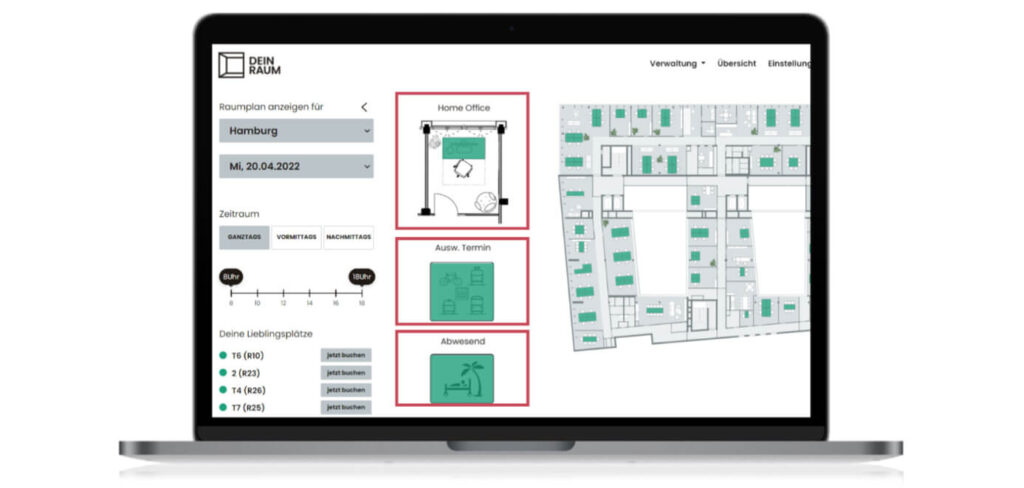
Digital solutions for desk sharing and parking booking help you manage these changing attendance patterns transparently and plan resource usage efficiently. Our desk-sharing software for flexible workplace booking supports you in introducing a hybrid working model. You can now test the DEIN RAUM application free of charge for 30 days at deinraum.io.
Frequently asked questions about the 30-hour workweek (FAQ)
⟵